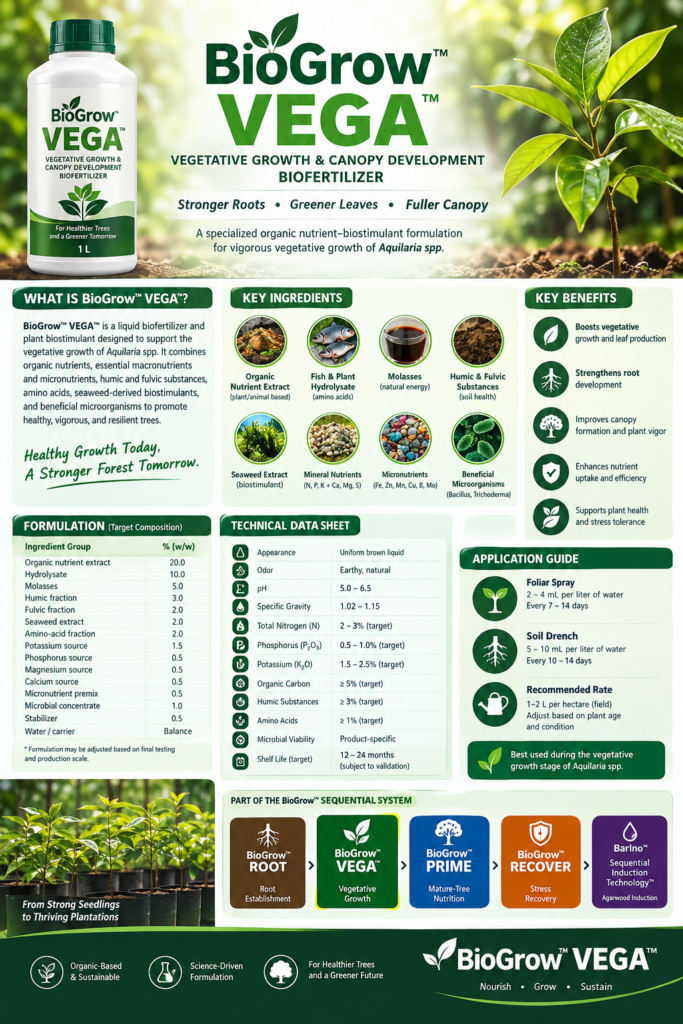
BioGrow™ VEGA is the vegetative-growth formulation within the BioGrow™ system, designed for developing young Aquilaria trees after nursery establishment and during the early plantation-growth phase. Its role is to promote balanced canopy, stem, branch and root development—not to induce agarwood resin directly. (Crown Agarwood Group)
Product Positioning
BioGrow™ VEGA™
Vegetative Growth & Canopy Development Formula
“Build the Tree Before You Build the Resin.”
| Component / Function | Proposed role |
|---|---|
| Organic nutrient base | Sustained nutrition and organic matter |
| Nitrogen | Leaf, shoot and vegetative development |
| Phosphorus | Root establishment and energy metabolism |
| Potassium | Structural strength, water regulation and stress tolerance |
| Calcium + Magnesium | Cell-wall development and chlorophyll function |
| Micronutrients | Support for enzymatic and physiological processes |
| Beneficial microorganisms | Rhizosphere activity and nutrient cycling |
| Humic/fulvic substances | Nutrient availability and soil interaction |
| Plant biostimulants | Support vigorous but balanced growth |
Target Growth Stage
Agaris™ Nursery → BioGrow™ ROOT → BioGrow™ VEGA → BioGrow™ PRIME
VEGA is best positioned for:
- Young transplanted trees
- Establishment through early vegetative growth
- Canopy expansion
- Stem and branch development
- Recovery from moderate transplant stress
- Preparing trees for subsequent intensive plantation management
Research on Aquilaria supports the general concept that appropriate organic/bio-organic nutrition can improve height, diameter, chlorophyll and nutrient status, while excessive fertilization can suppress benefits. (MDPI)
Product Architecture
BioGrow™ VEGA
1. Nutrient Matrix
Organic N + balanced P/K + Ca/Mg + micronutrients
2. Biological Matrix
Beneficial rhizosphere microorganisms
3. Carbon Matrix
Composted organic matter + humic/fulvic fractions
4. Biostimulant Matrix
Plant-derived growth-support compounds
5. Soil Interface
Designed to improve nutrient availability and biological activity
Commercial Specification
I would develop VEGA as a concentrated organic/biofertilizer, with the final guaranteed analysis established only after laboratory formulation and efficacy trials.
A reasonable development target could be:
BioGrow™ VEGA
- Liquid concentrate or soluble powder
- Moderate nitrogen
- Balanced P–K
- Secondary nutrients
- Chelated/available micronutrients
- Organic carbon
- Humic/fulvic fraction
- Compatible beneficial microbial consortium
Importantly, the exact N-P-K ratio and microbial CFU should be determined through formulation trials rather than simply copying a conventional fertilizer ratio. Studies on agarwood show that response is dose-dependent, with excessive fertilizer potentially reducing the benefit. (PubMed)
Application Concept
For commercial development, I would initially validate three VEGA programs:
VEGA-L — Light Growth
Young trees / lower fertility sites
VEGA-M — Standard Growth
Normal plantation vegetative development
VEGA-H — Intensive Growth
High-productivity plantation blocks
An earlier study of A. malaccensis seedlings found favorable growth responses using liquid organic fertilizer at relatively low concentrations and frequent application, illustrating why dose × frequency should be optimized experimentally rather than assumed. (Jurnal Untan)
Strategic Role in Crown Agarwood Group
BioGrow™ VEGA → Healthy Vegetative Biomass → Strong Plantation Trees → BioGrow™ PRIME → BarIno™ Induction → Agarwood Formation
The key distinction should remain:
VEGA grows and prepares the tree; it does not claim to create agarwood resin.
That separation makes the product scientifically and commercially stronger, because resin formation is a separate biological response associated with injury, infection and other induction mechanisms. (journal.unhas.ac.id)